Choosing the Right Solar Inverter for Industrial Use
- by vibrant
- 6 minute read
Choosing a solar inverter for industrial use is rarely about ticking a specification box. It’s about how the system behaves once it is tied into production lines, heavy loads, and a grid that doesn’t forgive instability.
In industrial solar projects, panels often get the attention. Inverters carry the responsibility.
A factory can tolerate marginal losses in generation. But it cannot tolerate erratic power quality, unexpected shutdowns, or systems that struggle when loads fluctuate. That is why solar inverter solutions for industrial use [anchor text to products page – Solar inverters] shape performance far more than their physical size suggests.
Before getting into models or architectures, it helps to step back and understand why inverter decisions look very different at an industrial scale.
Why Inverter Selection Is Critical in Industrial Systems
Industrial inverter selection can make or break system performance. While solar panels generate power, it’s the inverter that determines how efficiently and reliably that power is used.
Industrial operations demand:
- High uptime
- Stable power output
- Advanced monitoring
- Grid compliance
Factories don’t draw power politely. Loads surge, machines restart, and processes overlap. The inverter sits in the middle of all this activity, deciding how smoothly energy flows through the system.
When that control layer of inverters struggles, the symptoms ripple outward in the form of voltage instability, tripping, and unexpected downtime. That’s when inverter selection stops being a specification exercise and starts becoming an operational issue. The inverter must manage all of this while remaining synchronised with the grid.
Solar inverter solutions for industrial use must prioritise stability, control, and resilience. A poorly matched inverter can cause operational disruptions, and the domino effect of such disruptions is costly.
Central vs String Inverters: Making the Right Structural Choice
Most industrial projects begin with a familiar question: central or string inverters?
There is no universal answer. The right choice depends on how the facility operates, not on what works elsewhere.
Central Inverters
Central inverters are best suited for:
- Large ground-mounted systems
- Utility-scale projects
- High-capacity installations
They offer cost advantages at scale but require careful planning for redundancy.
String Inverters
String inverters are preferred for:
- Rooftop installations
- Modular system design
- Facilities planning phased expansion
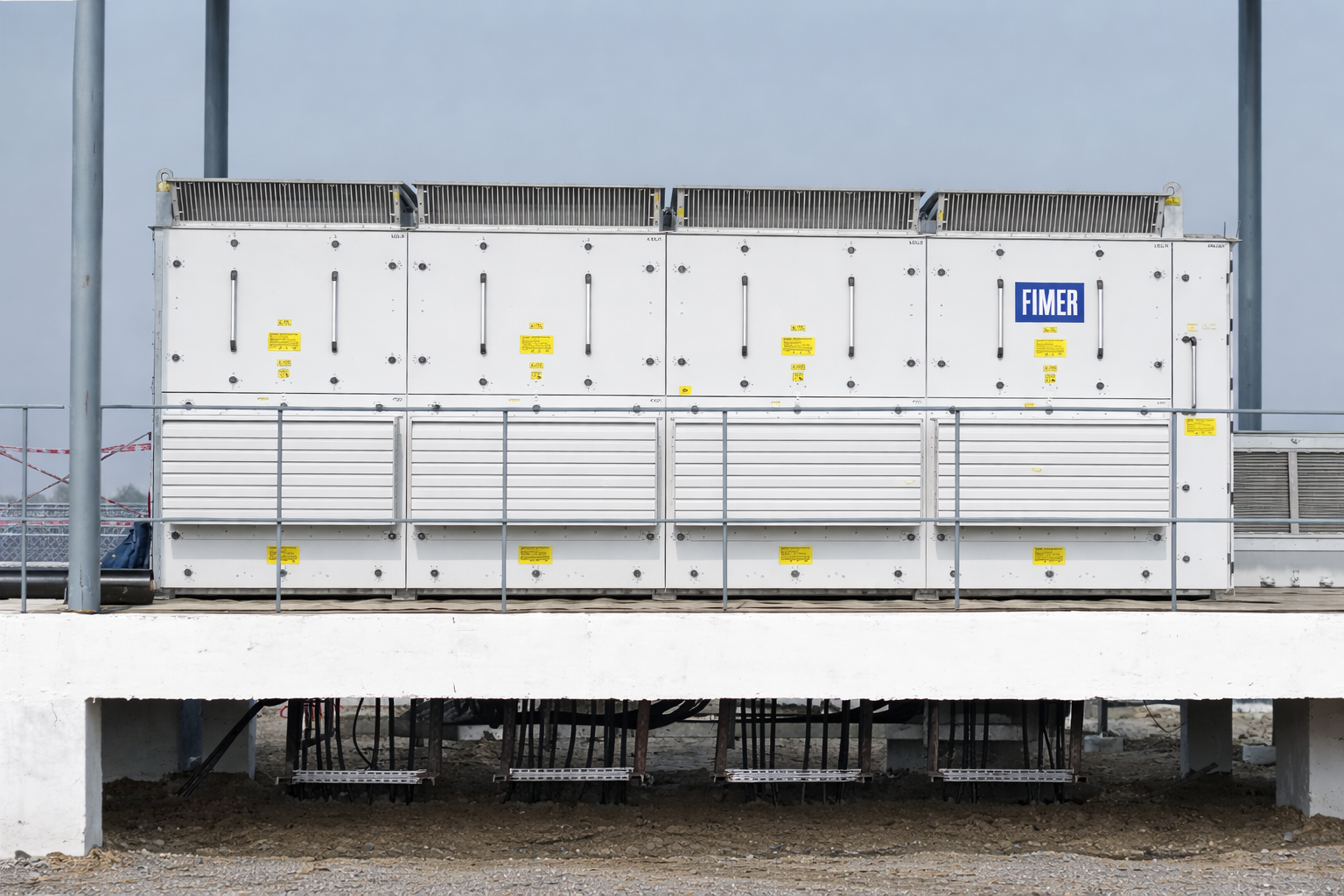
String inverters [anchor text-Brand page-Fimer] provide flexibility and easier maintenance.
While making this choice, industrial inverter selection stops being a technical preference and becomes a design decision. The wrong architecture does not always fail outright. It quietly limits adaptability.
Key Factors to Consider When Selecting an Industrial Inverter
Technical specifications matter, but they only tell part of the story. In industrial environments, how an inverter responds under stress matters more than how it performs under ideal conditions.
Load Behaviour and Operating Profile
As industrial loads are rarely static, inverters must handle sudden changes without destabilising output or tripping protections.
Oversimplifying load behaviour during planning often leads to undersized or poorly matched inverters. The system may work on paper, but struggle under real conditions.
Redundancy and Downtime Tolerance
Redundancy is not a luxury in industrial environments. It is risk management.
String inverters naturally distribute risk. Central systems require careful redundancy planning. The right approach depends on how costly downtime is for the facility and how quickly faults must be isolated.
Monitoring and Diagnostics
Industrial solar systems do not run unattended. Visibility is necessary for smooth operations. With the help of advanced monitoring, factories can detect faults, benchmark performance, and carry out preventive maintenance. When diagnostics are limited, it can often force reactive fixes, increasing downtime and service costs.
Grid Compliance and Protection
Industrial installations face stricter grid interaction requirements. Inverters must meet local grid codes, protection norms, and synchronisation standards.
Non-compliance doesn’t always block commissioning. Sometimes it restricts export capacity or triggers repeated faults later. Those are expensive problems to inherit.
Environmental and Site Conditions
Factories have ruthless environments. Heat, dust, vibration, humidity, and chemical exposure are common.
Inverter enclosures, cooling methods, and component ratings must match site realities. A technically capable inverter that overheats or degrades under site conditions adds hidden cost through derating or early replacement.
This is why solar inverter solutions for industrial use are evaluated not just on efficiency curves, but on how they behave after years on site.
Cost Considerations Beyond the Price Tag
Inverter pricing often focuses on upfront cost per kilowatt. That number rarely reflects lifetime impact.
Factors that influence long-term cost include:
- Failure rates and service intervals
- Spare availability and lead times
- Firmware support and upgrade paths
- Compatibility with future system expansion
A lower-cost inverter can look attractive initially. But if it limits scalability or increases service interruptions, the savings disappear quickly.
Common Mistakes in Industrial Inverter Selection
Some mistakes repeat across projects:
- Choosing inverters based solely on nameplate capacity
- Oversizing or undersizing capacity
- Ignoring future expansion needs
- Ignoring redundancy in continuous-operation facilities
- Underestimating environmental stress
- Treating inverters as interchangeable commodities
- Inadequate protection and monitoring features
These errors rarely cause immediate failure. These mistakes often surface only after commissioning. They crumble under load, during faults, or when expansion becomes necessary. Hence, choosing a solar inverter for industrial use demands context, not just comparison.
Role of the Solar Distributor in Inverter Selection
In industrial solar projects, inverter selection does not end with choosing a model. What matters just as much is how that inverter fits into the wider system and whether it arrives on site exactly as specified.
A specialised distributor [anchor text, link to website home page] helps ensure:
- Compatibility with panels and BOS components, so electrical and mechanical mismatches don’t surface later
- Availability and lead-time planning, especially for large volumes or phased deployments
- Accurate technical documentation and support, which simplifies approvals, commissioning, and handover
For industrial buyers, this support is practical, not optional. Besides reducing procurement risk, it protects design intent and prevents last-minute substitutions that quietly compromise system performance.
Final Thoughts
Choosing a solar inverter for industrial use is less about technology choice and more about operational alignment.
The right inverter supports stability, flexibility, and long-term performance under real industrial conditions. The wrong one may work, but only until conditions change.
For factories evaluating solar inverter solutions for industrial use, the question is not which inverter looks best on paper. It is which one continues to perform quietly when production pressures rise? That difference defines system reliability.